


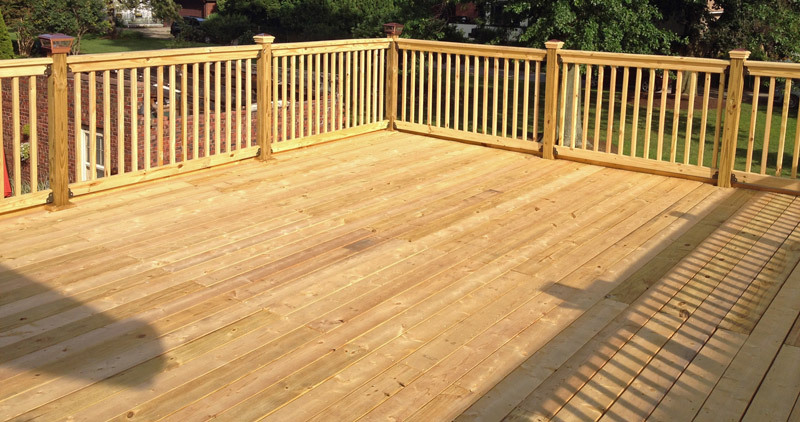
Wood is tough, renewable, and structurally efficient, but it remains a hygroscopic material throughout its service life. Even after a tree is harvested, sawn, dried, and installed in a deck, fence, pergola, or post, the wood continues to absorb and release moisture in response to its environment. As moisture content changes, wood swells and shrinks. Cracking occurs when those dimensional changes create internal stresses that exceed the strength of the wood.
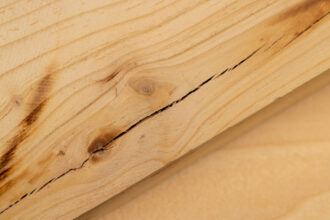
Cracks can appear alarming, particularly when they develop in newly installed lumber. In most outdoor applications, however, cracking is not a sign of product failure. Instead, it is a predictable physical response to moisture movement and uneven shrinkage. Understanding the mechanisms behind cracking makes it easier to distinguish cosmetic checking from conditions that warrant closer evaluation.
The science behind why wood cracks
Wood is hygroscopic, meaning it gains and loses moisture as surrounding humidity and exposure conditions change. As wood absorbs moisture it swells; as it dries it shrinks. These dimensional changes continue throughout the service life of the product. When moisture changes occur unevenly within a piece of wood, internal stresses develop. According to the USDA Forest Products Laboratory, cracking occurs when moisture-induced stresses exceed the tensile strength of the wood perpendicular to the grain.
Shrinkage is not equal in every direction
Wood shrinks anisotropically. Tangential shrinkage (around the growth rings) is greater than radial shrinkage (across the growth rings). This directional mismatch means that as wood dries, different regions attempt to shrink by different amounts. When this movement is restrained, stress accumulates and cracking can occur. USDA drying references identify uneven directional shrinkage as a primary contributor to drying defects such as checks and splits.
Moisture gradients are the primary driver
Cracks typically initiate when the surface of a board changes moisture content faster than the interior. The surface dries and attempts to shrink while the core remains wetter and dimensionally larger. This places the surface fibers in tension. If that tension exceeds the strength of the wood, stress is relieved through the formation of checks. Rapid changes in exposure—such as sudden drying after rainfall—magnify these moisture gradients and increase cracking risk.
End grain dries fastest
End grain allows moisture to move more rapidly than face grain. As a result, ends dry and shrink first, making end checks and end splits common, particularly in posts, timbers, and larger cross sections. USDA guidance on lumber drying notes that end drying is often the first location where drying stresses and cracks develop.
Checking versus splitting
A check is a crack that typically runs along the grain and originates at the surface as wood dries. Checks are common in larger cross sections such as 4x4s, 6x6s, and timbers, where the surface can dry significantly faster than the core. While checks can appear deep, they are often limited in structural significance.
A split is a more extensive separation of fibers that may extend through a significant portion of the cross section. Splits often originate from end checks that propagate further into the wood, from growth stresses, from fastener-induced stress, or from severe and repeated moisture cycling. Depending on location and severity, splits may affect structural performance or connections.
What cracking does and does not mean
In many outdoor applications, surface checking is primarily aesthetic and does not significantly reduce service life when wood is properly treated. The Southern Pine Inspection Bureau notes that checking is a normal condition of treated wood products and rarely diminishes durability. However, certain cracking patterns and exposure conditions warrant closer evaluation.
Checking, preservative distribution, and decay risk in non-stabilized treated wood
While most surface checking is cosmetic, checking in non-stabilized treated wood can introduce secondary durability concerns over time. Pressure treatment does not always result in perfectly uniform preservative distribution throughout a piece of lumber. Variability can occur due to wood density, heartwood content, species anatomy, and local permeability.
When checks form and open during service, they can expose interior zones that received lower preservative retention or were less effectively penetrated during treatment. These newly exposed surfaces absorb moisture rapidly and may remain wet longer after rainfall events. In environments with repeated moisture exposure, this condition can allow localized decay to initiate within deep checks, even when surrounding wood remains sound. This does not indicate treatment failure, but it highlights how checking can alter internal moisture exposure over time.
Why intermittent rainfall accelerates checking
Intermittent rainfall is one of the most aggressive drivers of checking in outdoor wood. Short rain events wet the surface fibers, causing them to swell. When rain stops and sun or wind follows, the surface dries rapidly while the interior remains wet. This repeated wet-dry cycling creates large and frequent moisture gradients that intensify surface stress.
Because the wood rarely reaches moisture equilibrium under intermittent exposure, these cycles repeatedly reload the same stress pathways. Over time, intermittent rainfall produces deeper and more frequent checks than steady wet or steady dry conditions. USDA research on drying and weathering emphasizes that rapid surface drying and repeated moisture gradients are key contributors to surface checking and splitting.
How preservation and stabilization work together
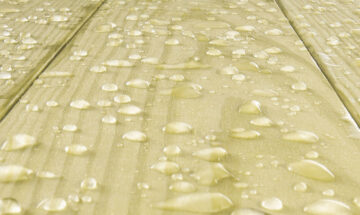
Preservative treatments are designed to protect wood from biological threats such as decay fungi and termites. Stabilization addresses a different, but related, challenge: moisture movement. Water-repellent stabilizers reduce the rate and extent of water uptake and slow drying, which moderates moisture gradients and reduces the stresses that cause checking, splitting, and warping.
USDA research on end coatings and drying control demonstrates that slowing moisture movement reduces cracking. Built-in stabilizers function on the same principle during service by moderating how quickly wood responds to wetting and drying cycles.

Why stabilized treated wood, such as Ecolife, can reduce checking and warp
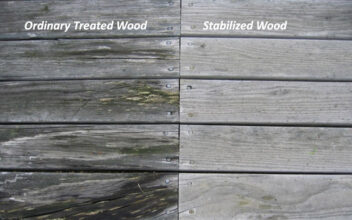
Some treated wood systems incorporate an integrated stabilizer and water repellent as part of the preservative treatment. Ecolife treated wood is one example. Ecolife® includes a built-in stabilizer designed to reduce water absorption, moderate wet-dry cycling, and improve dimensional stability. Mechanistically, reduced water uptake leads to smaller swelling events, slower drying reduces moisture gradients, and reduced cycling lowers the stresses that drive checking, splitting, cupping, and warping.
Field testing by Viance shows that Ecolife can reduce checking, splitting, and warping by up to 50 percent compared to non-stabilized treated lumber in similar exposure conditions. This does not mean cracking is eliminated, but rather that cracks tend to be fewer, less severe, and slower to develop, particularly during the critical first year of outdoor exposure.
An additional practical benefit is reduced early maintenance pressure. Because the water-repellent component is integrated into the treatment, Ecolife does not require an added water repellent for up to two to three years, helping smooth the intense moisture cycling that often occurs immediately after installation.
Conclusion
Wood cracks because it is a hygroscopic, anisotropic material responding to moisture movement and internal stress. Most surface checks are cosmetic, but crack formation can influence moisture exposure and long-term durability, particularly in non-stabilized treated wood. Decades of USDA research show that controlling moisture movement—by slowing wetting and drying and reducing moisture gradients—is the most effective way to reduce checking and splitting.
When wood preservation is combined with stabilization, as in systems like Ecolife, both biological durability and dimensional stability are addressed. The result is treated lumber that not only resists decay and insects, but also maintains better appearance, straighter boards, and more consistent performance over time.
Sources and References
https://www.fpl.fs.usda.gov/documnts/fplgtr/fplgtr282/chapter_13_fpl_gtr282.pdf - USDA Forest Products Laboratory – Drying and moisture-related defects in wood
https://www.spib.org/resources/treated-faqs - SPIB
https://www.treatedwood.com/products/ecolife - Viance - Ecolife
https://awpa.com/images/public/How_to_Specify_Treated_Wood.pdf - AWPA