



The Evolution of DCOI and Viance's History of Wood Protection Innovation
A chemistry first developed to solve a problem on ship hulls has traveled an unusual path into residential lumber, utility infrastructure, and now railroad crossties. Its story shows how wood preservation has continued to evolve alongside changing performance and environmental expectations. |
Wood remains one of the world's most versatile construction materials. Its long-term performance, however, depends on technologies that protect it from fungal decay, insect attack, moisture, and years of environmental exposure. As performance expectations and environmental considerations have evolved, so have the preservatives used to protect it.
Few wood-preservative chemistries have successfully crossed multiple industries. DCOI is one of them. Originally developed for marine antifouling coatings, 4,5-dichloro-2-n-octyl-4-isothiazolin-3-one, commonly known as DCOI, has since been adapted for residential lumber, utility infrastructure, and railroad crossties. Its progression helps illustrate a larger story: wood-preservation technology can change substantially while wood itself remains a durable, renewable infrastructure material.
Today, DCOI is used in applications ranging from marine coatings and water-treatment systems to treated wood products. Viance has helped translate that active ingredient into application-specific preservative systems for residential and infrastructure markets. 1
A Legacy of Innovation Before Viance

Viance, LLC has operated since 2007. The company was formed from two organizations with long histories in chemical research and wood-preservation technology: the biocides business of Rohm and Haas Company and the wood-protection chemicals business of Chemical Specialties Inc. (CSI). That technical heritage includes earlier advances such as D-Blaze® fire-retardant treated wood, Ultrawood™ water repellents and stabilizers, and Preserve® ACQ. 1
Preserve ACQ became especially important as the residential treated-wood market transitioned away from chromated copper arsenate for most consumer applications. In 2002, the U.S. Environmental Protection Agency recognized CSI with a Presidential Green Chemistry Challenge award for Preserve ACQ, citing the elimination of arsenic and hexavalent chromium from the preservative system. 24
At roughly the same time, another line of research was unfolding far from lumber yards and treating plants. Its first proving ground was the ocean.
DCOI's First Challenge Was at Sea
During the 1980s and 1990s, growing concern over organotin antifouling coatings, particularly tributyltinoxide, or TBTO, pushed the marine industry to search for alternatives. Antifouling coatings prevent plants, microorganisms, and animals from building up on ship hulls, where fouling increases drag and fuel use. Organotin chemistries were effective, but their persistence and environmental effects led to tighter restrictions and a search for different approaches. 3

Rohm and Haas began a research program to identify a more environmentally compatible antifouling chemistry. EPA records from the 1996 Presidential Green Chemistry Challenge describe more than 140 isothiazolone compounds screened for antifouling activity in laboratory and field tests. The candidate selected for commercial development was DCOI, which became the active ingredient in SEA-NINE™ 211N marine antifoulant technology. 3
The challenge was not simply to find a chemistry capable of controlling marine growth. Antifouling products must be biologically active against organisms trying to colonize submerged surfaces. The environmental question therefore depends heavily on exposure: how much chemistry is needed to work, how long it remains in the environment, and whether it accumulates over time.
Data supplied by LANXESS for this article illustrate DCOI's activity against several representative marine fouling organisms. The concentrations are small, in some cases only a few thousandths of a part per million. The chart is best read as an efficacy snapshot, not as a direct toxicity comparison across every organism. The barnacle value, for example, is reported as an LC50 rather than a minimum inhibitory concentration.
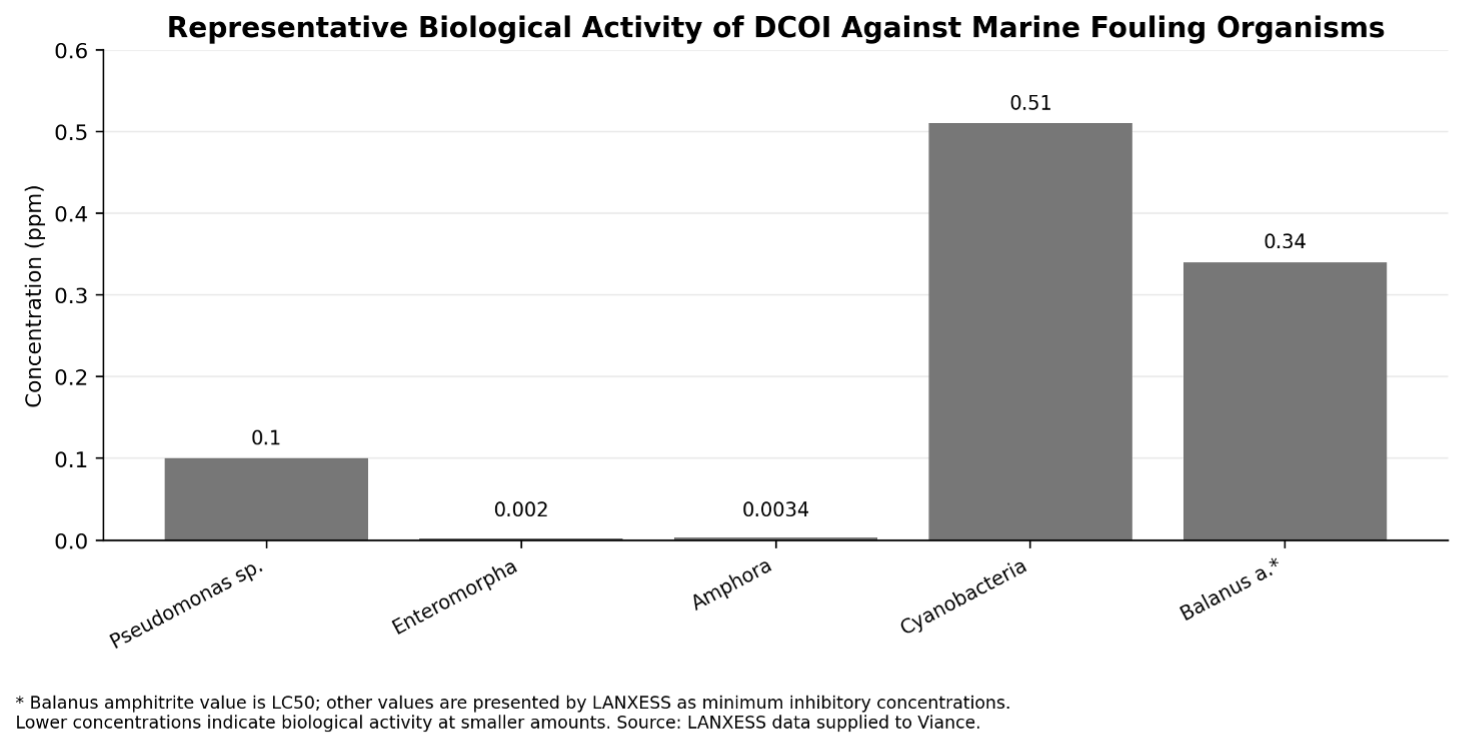
Figure 1. Representative marine biological activity data supplied by LANXESS. Original LANXESS material labels the chemistry DCOIT; this article uses the industry shorthand DCOI for consistency.
Just as important was what happened after the chemistry entered the marine environment. EPA's award documentation reported that SEA-NINE 211N degraded with a half-life of about one day in seawater and about one hour in sediment. By comparison, the same EPA summary reported much slower degradation for TBTO and bioaccumulation factors for tin as high as 10,000-fold, while bioaccumulation of SEA-NINE 211N was described as essentially zero. EPA also noted an important distinction: both chemistries were acutely toxic to marine organisms, but widespread chronic toxicity was reported for TBTO, while the SEA-NINE 211N testing cited in the award summary did not show chronic toxicity. 3
LANXESS supplied more detailed temperature-dependent dissipation data that support the same basic point. DT50 is the time required for half of a substance to dissipate from a given environment. At 9°C, the reported DT50 was 14 hours in marine water and less than 3.6 hours in marine sediment. At 20°C, those values fell to 5.8 hours in water and less than one hour in sediment.
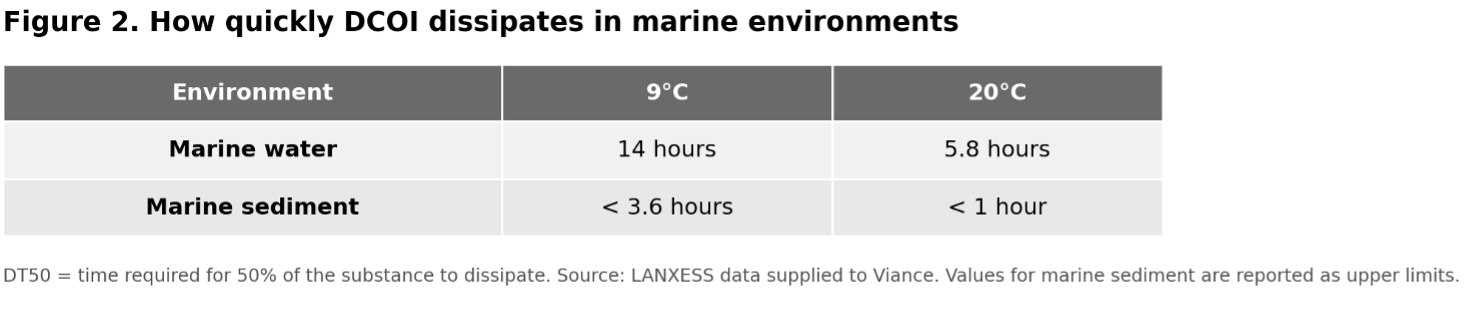
Together, the efficacy and environmental-fate data help explain why DCOI represented a significant change in marine antifouling chemistry. It could provide the biological activity required to resist fouling while limiting prolonged environmental exposure through rapid degradation and low bioaccumulation. In 1996, Rohm and Haas received EPA's Presidential Green Chemistry Challenge Designing Greener Chemicals Award for the SEA-NINE 211N technology. 23
Those same characteristics also attracted attention in wood preservation. The service environment was different, but the central challenge was familiar: control destructive biological organisms while managing how the active ingredient behaves outside the product. DCOI had already entered the wood-preservation arena and was standardized by the American Wood Protection Association in 1989. It is listed as P-39 in the AWPA Book of Standards. 5
Bringing Biocide Expertise and Wood-Preservation Experience Together
When Viance was established, it combined deep experience in active-ingredient chemistry with decades of knowledge about wood treatment, formulation, production, and end-use markets. That combination mattered because the same active ingredient does not simply move unchanged from one industry to another.
Marine coatings, residential lumber, utility poles, and railroad ties face very different exposure conditions. The useful innovation is not merely that DCOI can work in each market. It is that preservative systems can be formulated around the same active ingredient to meet the performance demands of each application.
Why DCOI Matters in Wood Preservation
DCOI is a broad-spectrum organic biocide effective against fungi, bacteria, and other microorganisms responsible for biological deterioration. In wood-preservative systems, its value extends beyond efficacy alone. DCOI is not classified as a Restricted Use Pesticide by the U.S. EPA, and the active ingredient itself contains no metals. Viance also reports very low water solubility, less than 5ppm, together with a high soil adsorption coefficient, characteristics associated with low mobility and strong leach resistance in properly formulated treated wood. 6
Its adaptability is equally important. Viance has developed different DCOI-based systems for very different wood products rather than relying on one formulation for every use. That approach helped move DCOI from above-ground residential lumber to critical utility infrastructure and, more recently, railroad crossties.
Ecolife: Expanding DCOI Into Residential Lumber
One of DCOI's first major commercial successes in wood preservation came through Ecolife®. Viance launched Ecolife for residential markets in 2008. Its EL2 preservative system uses DCOI for biological protection in above-ground applications such as decking, deck framing, railings, beams, porches, gazebos, and playsets. 1 7
Ecolife also demonstrates why formulation matters. Outdoor lumber faces more than decay fungi and termites. Repeated wetting and drying can contribute to checking, splitting, cracking, and dimensional change. Ecolife pairs DCOI-based protection with an integrated water-repellent stabilizer system designed to reduce water uptake and improve weathering performance. 7
The result was an early large-scale demonstration that DCOI could be adapted successfully for a familiar consumer wood product. The next step would put the chemistry into a far more demanding service environment.
DCOI Moves Into Critical Infrastructure
In 2018, Viance developed the first oil-borne DCOI preservative platform for infrastructure applications, including utility poles and crossarms. UltraPole® NXT was designed for wood poles expected to remain in service for decades while exposed to ground contact, moisture, fungi, insects, weather extremes, and structural loads. 1 5
By that time, DCOI already had decades of wood-preservation field history. Viance cites 28 years of stake-test data compiled by Mississippi State University. Those data helped support the chemistry's evaluation for long-life infrastructure applications. 6
The timing soon became especially important. The last global manufacturer of pentachlorophenol, commonly called penta, ended production in December 2021. Because penta had protected utility poles for generations, utilities and pole producers needed established alternatives that could preserve the advantages of wood infrastructure. 5
DCOI was already positioned for that transition. UltraPole NXT provides an oil-borne, non-metal-based preservative system compatible with conventional utility hardware and industry treatment practices. Viance reports that the formulation contains no heavy metals, dioxins, furans, or polycyclic aromatic hydrocarbons. 5
The utility market provided an important lesson for the next industry in DCOI's path: evaluating alternatives before they are urgently needed gives infrastructure owners more time to build experience, diversify supply options, and understand performance in service.
Why Railroads Are Evaluating New Preservative Technologies
Railroads are not in the same position utilities faced during the penta transition. Creosote remains an established railroad-tie preservative, and the industry's immediate challenge is not a single regulatory deadline forcing a wholesale change.
Even so, there is value in evaluating additional preservative technologies before external pressures dictate the pace of adoption. More options can improve supply resilience, give railroads greater flexibility in long-term planning, and allow performance to be evaluated through real-world service experience rather than under the pressure of an abrupt market transition.
The Next Stop: UltraTie
UltraTie™ represents the latest stage in DCOI's progression through wood-preservation markets. Building on experience with residential lumber and utility infrastructure, UltraTie adapts the DCOI platform to railroad crossties.
AWPA standards now include DCOI-treated crossties manufactured from mixed hardwoods, oak and hickory, Coastal Douglas-fir, Western Hemlock, Western Larch, Southern Pine, and Ponderosa Pine. Viance also reports that UltraTie crossties are being evaluated under active service conditions by short-line and Class I railroads. 6

For railroads, the value proposition extends beyond preservative performance alone. DCOI-treated ties offer a lower-odor, non-metal-based alternative preservative platform within familiar wood-tie supply chains. The active ingredient is not classified as a Restricted Use Pesticide, has very low water solubility, and has demonstrated strong leach resistance in wood-preservative systems. 6
The larger point is not wood versus another material. It is the continued expansion of the technologies available to protect wood so railroads can preserve the operational, economic, and sustainability advantages that have kept timber ties central to track infrastructure for generations.
The Evolution Continues
A common theme runs through this history: wood protection advances by matching chemistry to the demands of the application. Preserve ACQ helped reshape residential treated lumber. Ecolife combined DCOI-based biological protection with integrated stabilization. UltraPole NXT and UltraArm NXT adapted DCOI to long-life utility infrastructure. UltraTie now carries that progression into railroad applications.
The marine data that began the DCOI story help explain why the chemistry attracted attention in the first place. DCOI was not valuable because it lacked biological activity. Quite the opposite. It was effective at very low concentrations, but it was also designed to degrade rapidly and avoid the long environmental persistence associated with the organotin chemistries it was developed to replace.
That distinction still matters as DCOI moves from one service environment to another. The active ingredient remains the common thread, but the formulations, carriers, treatment processes, and performance requirements change with the product. Each market therefore becomes another chapter in the same technical evolution.
Whether DCOI ultimately becomes a major railroad preservative will be determined through continued field performance, operational experience, and industry acceptance. What is already clear is that the chemistry has traveled an uncommon path, from ship hulls to residential decks, utility poles, and now the railroad track.
Few wood-preservation technologies can claim a similar record of adaptation across such different applications. That continuing evolution remains central to Viance's approach to wood protection.
Sources
1. Viance, LLC. “About Viance.” https://www.treatedwood.com/about-viance
2. U.S. Environmental Protection Agency. “Green Chemistry Challenge Winners.” https://www.epa.gov/greenchemistry/green-chemistry-challenge-winners
3. U.S. Environmental Protection Agency. “Presidential Green Chemistry Challenge Awards Program: Summary of 1996 Award Entries and Recipients.” https://nepis.epa.gov/Exe/ZyPURL.cgi?Dockey=20000XD4.TXT
4. U.S. Environmental Protection Agency. “Green Chemistry.” https://www.epa.gov/greenchemistry
5. Viance, LLC. “UltraPole NXT and Crossarms with DCOI.” https://www.treatedwood.com/products/ultrapolenxt
6. Viance, LLC. “UltraTie - DCOI Rail Ties.” https://www.treatedwood.com/ultratie
7. Viance, LLC. “Product Specifications and Information: Ecolife.” https://www.treatedwood.com/accordion/specifications-and-product-information
8. LANXESS. Marine biological activity, environmental fate, and degradation-product data supplied to Viance for editorial.